
Beyond Auschwitz
Places and History of the Holocaust in the Lublin District
The Ghettos
The transit ghettos established in the Lublin District were a significant component of the Nazi killing process. Short-lived but consequential, they served as temporary sites of confinement for Jews from the region and from other parts of Europe before deportation to forced labor camps and killing centers. Their history helps show how genocide in this region unfolded step by step, through a network of places.
Read more
Zamość
Zamość was home to a longstanding Jewish community before the Holocaust. During the German occupation, the town became a site of ghettoization, forced labor, and deportation, as Jews from the town and the surrounding region were drawn into the machinery of Operation Reinhard. Many were later deported to Bełżec and other camps. The history of Zamość reflects how a center of Jewish life was systematically dismantled and destroyed in view of the local population and German civilians.

Włodawa
Włodawa, near the present-day borders with Belarus and Ukraine, had a long-established Jewish community. During the German occupation, its synagogue complex was used by the SS as a collection and storage site. Many Jews from Włodawa and the surrounding area were deported to nearby Sobibór, just 12 kilometers away. Today, the preserved synagogue stands as a rare witness to the region’s rich Jewish life and its destruction.

Poniatowa
Poniatowa became the site of a forced labor camp for Jews brought to the Lublin district from the Warsaw Ghetto prior to its liquidation in winter and spring of 1943. Prisoners, who also included deportees from Slovakia, Germany, and Austria, were exploited in textile and armaments production under brutal conditions. In November of that same year, during the “Harvest Festival” massacre, approximately 14,000 Jews were murdered there in a single day.

Piaski
In 1942, the village of Piaski was turned into a transit ghetto. Jews from the Lublin region, as well as from Germany and the Protectorate of Bohemia and Moravia, were concentrated there before deportation to Bełżec, Sobibór, and Majdanek. Overcrowding, hunger, and disease claimed many lives even before deportation. Piaski shows how small localities were absorbed into the wider machinery of genocide.

Kraśnik
Before the Holocaust, Kraśnik was home to a substantial Jewish community that played an important role in the town’s commercial and communal life. Under German occupation, Jews were confined, exploited as forced laborers, and deported to Bełżec, while the town also served as a collection point for Jews from nearby localities. Kraśnik illustrates how established Jewish communities across the district were dismantled through confinement, forced labor, and deportation.

Józefów
Józefów became the site of one of the most notorious mass shootings in the Lublin District. On 13 July 1942, German Reserve Police Battalion 101 murdered much of the town’s Jewish population in the nearby forest, while others were deported to camps. Józefów reveals how the destruction of Jewish communities in the region was carried out not only in killing centers, but also in forests and fields close to home.

Izbica
Izbica served as one of the major transit ghettos of Operation Reinhard. Jews from the Lublin region, as well as from Germany, Austria, and the Protectorate of Bohemia and Moravia, were concentrated there before deportation to Bełżec and Sobibór. Overcrowding, hunger, and violence made survival extremely difficult. Izbica shows how small towns in the region were transformed into temporary holding sites on the road to extermination.

Trawniki
The SS and Police Leader’s office in Lublin formally established the SS forced labour camp at Trawniki in spring 1943. A Jewish forced labour camp, however, had already existed in the village for approximately two years. It was created in autumn 1941 at roughly the same time as the neighbouring SS training camp.
What were Ghettos?
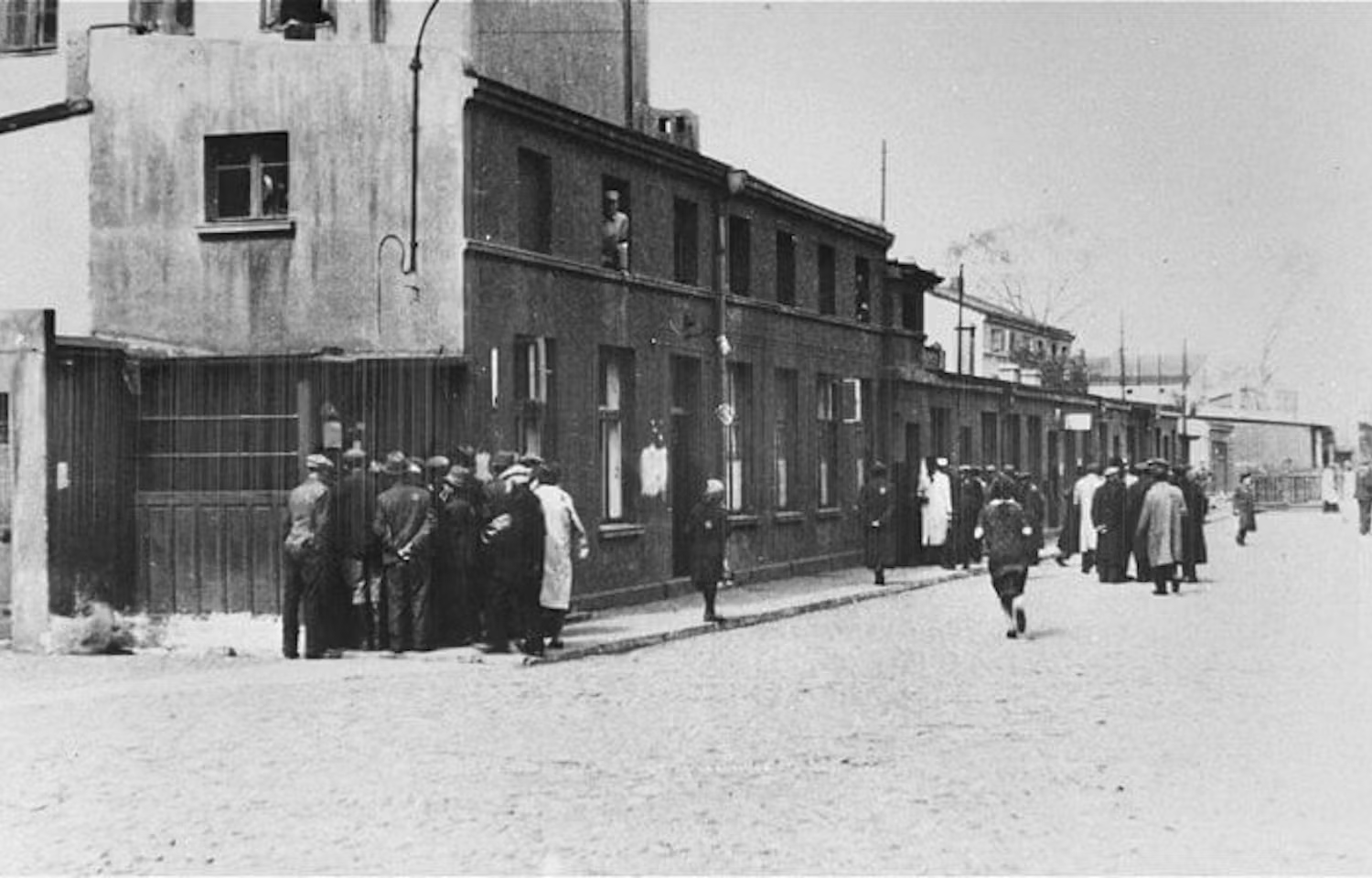
The ghettos of the Lublin District belonged to a system of more than a thousand across German-occupied eastern Europe, ranging from open ghettos in small towns to the sealed Warsaw Ghetto. Learn what ghettos were and their role in the Holocaust at About Holocaust, the educational platform of the WJC and UNESCO.
The Killing Centers
The killing centers connected to Operation Reinhard were central to the murder of the Jews of occupied Poland and beyond. At Bełżec and Sobibór, entire transports were sent directly to their deaths, while Majdanek became part of the wider system of imprisonment, forced labor, and mass murder. These sites make visible how genocide in and around the Lublin District was organized, accelerated, and carried out.
Read more
Majdanek
Majdanek was a concentration and labor camp on the outskirts of Lublin that also functioned as a site of mass murder. Prisoners were held there under brutal conditions, exploited as forced laborers, and murdered on a large scale. On 3 November 1943, during the “Harvest Festival” massacre, approximately 18,000 Jews were shot at Majdanek in a single day. Majdanek shows how the Nazi camp system combined imprisonment, exploitation, and killing within a single place.

Sobibór
Sobibór was one of the three Operation Reinhard killing centers, where Jews deported from occupied Poland and other parts of Europe were murdered shortly after arrival. Isolated and purpose-built for killing, the camp became a central site in the Nazi program of extermination. Sobibór is also remembered for the prisoner uprising of October 1943, one of the most significant acts of Jewish resistance during the Holocaust.

Bełżec
Bełżec was the first of the killing centers in the Lublin District to begin operation. Between March and December 1942, hundreds of thousands of Jews were murdered there, most of them deported from the districts of the General Government. Almost no one survived Bełżec; only a handful of survivors are known, which is part of why the camp remains far less known than Auschwitz. Bełżec reflects the speed with which the Nazi program of mass murder was put into effect.